
US Expat Taxes in Colombia: FBAR, FATCA & What You Actually Owe
FBAR, FATCA, FEIE, or Foreign Tax Credit? Here's what US expats in Colombia actually need to file, which forms matter, and why the FTC usually beats the FEIE.


I was sitting in a Juan Valdez in Laureles, halfway through my second tinto, when my accountant back in the States texted me: "Did you report your Nequi account on your FBAR?" I stared at my phone for a solid thirty seconds. My Nequi. The app I use to split the bill at restaurants and pay my gym membership. Turns out, the IRS considers that a foreign financial account — and not reporting it can cost you $16,536 per violation.
The US is one of only two countries on Earth (shoutout Eritrea) that taxes citizens on worldwide income regardless of where they live. So if you're an American in Colombia — whether you're working remotely from El Poblado, freelancing from Santa Marta, or retired in Pereira — you still owe Uncle Sam a tax return every year. And beyond the return itself, there's a maze of reporting forms with penalties that make the actual tax bill look friendly.
I've been filing from Colombia for a while now, and I've made most of the mistakes I'm about to warn you about. Here's what I wish someone had told me before my first April 15th abroad.
FBAR: Your Nequi Counts (Yes, Really)
The FBAR — officially FinCEN Form 114 — is probably the most misunderstood filing requirement for Americans abroad. It's not part of your tax return. It doesn't go to the IRS directly. You file it electronically through the BSA E-Filing system, and it goes to the Financial Crimes Enforcement Network. Sounds dramatic, right? That's because the penalties are dramatic too.
Here's the rule: if the aggregate value of all your foreign financial accounts exceeds $10,000 at any point during the calendar year, you must report every single account. Not just the ones over $10,000 — all of them. So let's say you've got $6,000 sitting in Bancolombia and $5,000 in your Nequi wallet on the same day in March. That's $11,000 aggregate. You now need to report both accounts, even if neither one individually hit the threshold.
And here's what catches most expats in Colombia: Nequi and Daviplata are bank accounts. Nequi is technically a Bancolombia product. Daviplata is Davivienda's. They show up on your banking records. The IRS doesn't care that you only use Nequi to buy empanadas from the street vendor — it's a foreign financial account and it needs to be on your FBAR.
Other accounts that count: CDTs (those fixed-term deposits your Colombian partner might have talked you into), any savings accounts, and foreign-based crypto exchanges like Binance.com. US-based platforms like Coinbase or Kraken don't count since they're domestic. If you're actively trading crypto and need help tracking your cost basis, CoinTracking is what I use — it pulls from most exchanges and generates the IRS forms you need.
The deadline is April 15, but there's an automatic extension to October 15 with no form required. Just file it before October and you're fine. The real kicker is penalties: after the Supreme Court's 2023 Bittner ruling, non-willful penalties are $16,536 per report (not per account), which is slightly less terrifying than the old interpretation. Willful violations? Up to $131,210 per account or 50% of the account balance — whichever is greater. Criminal charges are also on the table. Don't mess around with the FBAR.
FATCA (Form 8938): The Other Reporting Requirement
If you just read the FBAR section and thought "okay, I'll file that and I'm covered," I have bad news. FATCA — the Foreign Account Tax Compliance Act — is a completely separate requirement with its own form (Form 8938) and its own thresholds. The government really wants to know about your money abroad.
The good news for expats is that the thresholds are much higher if you live outside the US. You only need to file Form 8938 if your foreign financial assets exceed $200,000 on the last day of the tax year, or $400,000 at any point during the year (for single filers). Married filing jointly doubles those numbers. Compare that to the FBAR's $10,000 threshold — most expats in Colombia will hit the FBAR requirement long before FATCA kicks in.
Unlike the FBAR, Form 8938 gets filed with your tax return — it's attached to your 1040. It also covers a broader range of assets beyond just bank accounts: foreign stocks, securities, partnership interests, and financial instruments issued by foreign entities. The overlap with FBAR is real — most of your Colombian bank accounts need to go on both forms. Yes, it's redundant. No, the IRS doesn't care.
Penalties for not filing: $10,000 for failure to file, plus up to $50,000 in additional penalties if you still don't file after IRS notification. And here's the part that really hurts — there's a 40% penalty on any underpayment of tax attributable to undisclosed foreign assets. The government isn't subtle about wanting this information.
The Foreign Earned Income Exclusion: Not Always the Best Move
Most expat tax blogs will tell you the Foreign Earned Income Exclusion (FEIE, Form 2555) is the holy grail — you can exclude up to $132,900 of foreign earned income from US taxes in 2026. And yeah, that sounds amazing. But I'd argue that for most Americans in Colombia, the Foreign Tax Credit (next section) is actually the better choice. Let me explain both.
To qualify for the FEIE, you need to pass one of two tests. The Physical Presence Test requires you to be physically outside the US for 330 full days in any 12-month period. That's not a calendar year — you can pick any 12-month window. A quick trip home for Thanksgiving and Christmas can easily eat into those 35 allowed days in the US, though, so you need to be careful. The Bona Fide Residence Test is more flexible — you need to be a bona fide resident of a foreign country for an entire tax year. This is fuzzier and based on factors like your intention to stay, your ties to Colombia, your lease, your visa status. Most expats who've been in Colombia for a full calendar year can qualify under either test.
Here's where the FEIE falls short in Colombia specifically. First, it only covers earned income — salary, freelance payments, consulting fees. It does nothing for investment income, rental income, capital gains, or retirement distributions. If you're living off a mix of remote work and investment returns, only part of your income gets excluded. Second — and this is the big one — the FEIE does not eliminate self-employment tax. If you're a freelancer billing $100,000 from your apartment in Medellín, you can exclude it from income tax but you still owe the 15.3% SE tax. That's over $15,000 you can't avoid with the FEIE.
Third, once you elect the FEIE, revoking it locks you out for five years without IRS approval. So if your tax situation changes — maybe you start earning investment income or your Colombian tax bill goes up — you're stuck with a suboptimal choice.
Foreign Tax Credits: Why They Usually Win in Colombia
Honestly, the Foreign Tax Credit (FTC, Form 1116) is what I'd recommend for most Americans living and paying taxes in Colombia. Here's why: Colombia's income tax rates go up to 39% for high earners. The US top federal rate is 37%. When you're paying more in Colombian taxes than you'd owe in US taxes, the FTC gives you a dollar-for-dollar credit that can completely wipe out your US tax liability — and you can carry forward excess credits for up to 10 years.
Let's run a quick scenario. Say you earn $100,000 in Colombia and you're in the 25% Colombian bracket. You paid $25,000 in Colombian income tax. Your US tax on $100,000 might be around $17,000. With the FTC, you get a $17,000 credit (capped at your US liability) and carry forward the remaining $8,000 in excess credits. Your US tax bill: $0, and you've got credits banked for next year. With the FEIE, you'd also zero out your income tax, but if you're self-employed, you'd still owe SE tax on top of whatever you paid Colombia.
The FTC also covers all types of income — investment, rental, capital gains — as long as you paid foreign tax on it. And there's no physical presence test to worry about. The one downside is paperwork: Form 1116 is notoriously annoying, with separate categories for different income types. But the tax savings in a high-tax country like Colombia almost always make it worth the hassle.
One more thing: you can use the FEIE and FTC together, but only on different income. You can't double-dip. Most tax pros I've talked to in the Colombia expat community say the FTC alone is the cleaner, more beneficial option here.
The No-Treaty Problem (And Why It Matters)
The US and Colombia have no comprehensive income tax treaty. That's a bigger deal than most expats realize. A tax treaty would give you things like reduced withholding rates on dividends, a tiebreaker rule for dual-residency disputes, and potentially a totalization agreement for Social Security. Without one, you're exposed on multiple fronts.
No totalization agreement means that if you're self-employed, you could theoretically owe Social Security contributions to both countries. In practice, Colombia doesn't aggressively pursue this for remote workers on contractor setups, but it's a gray area that a treaty would resolve. There's also no formal mechanism to avoid double taxation beyond the FTC — which works, but isn't as clean as treaty-based relief.
The two countries do have a Tax Information Exchange Agreement (TIEA), though, so don't assume the DIAN and IRS aren't talking. Colombian banks also report under FATCA's intergovernmental framework, meaning your Bancolombia account balances are being shared with the US government. If you're thinking about just... not filing... they probably already know about your accounts.
Colombia's 183-Day Rule: When You Become a Colombian Taxpayer Too
Spend 183 or more days in Colombia within any 365-day rolling period and congratulations — you're now a Colombian tax resident. That means Colombia wants to tax your worldwide income too, not just what you earn locally. Combined with the US doing the same thing, you're looking at two countries claiming the right to tax everything you make.
This is where the FTC becomes essential. You'll file a Colombian tax return with the DIAN (usually by October), pay Colombian tax on your worldwide income, and then claim those payments as credits on your US return. The math usually works in your favor because Colombian rates are generally equal to or higher than US rates, so your US bill drops to zero or close to it.
If you want to stay under the 183-day threshold to avoid Colombian tax residency, you need to be disciplined about tracking your days. And be aware that Colombia uses a rolling 365-day window, not a calendar year — so spending November through June in Colombia over two calendar years still adds up. For the full breakdown on how this rule works and strategies for managing it, check out the guide below.
State Taxes: The Trap Nobody Warns You About
Here's something that blindsides a lot of people: moving to Colombia doesn't automatically end your state tax obligations. Some states are stickier than others, and if you left from the wrong one, they may still consider you a resident.
California is the worst offender. The Franchise Tax Board presumes you intend to return if you leave, and they'll keep taxing you until you prove otherwise. Virginia is similar — they don't have a clean "safe harbor" for people who move abroad. New York will release you, but only if you can prove you've established a domicile elsewhere, and "elsewhere" generally needs to be a specific address, not just "I live in Colombia now."
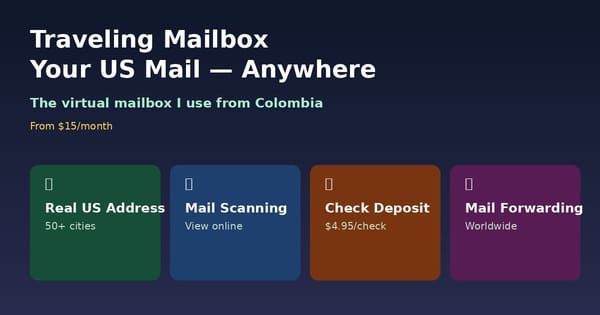
The smart play, if you're planning ahead: establish residency in a no-income-tax state (Florida, Texas, Nevada, Wyoming) before you move abroad. Get a driver's license, register to vote, open a bank account, maybe use a mail forwarding service. This way, when you leave the country, you're leaving from a state that doesn't care about taxing you. If you've already left from California, talk to a tax professional about the domicile change process — it's doable but you need documentation.
Behind on Filing? The Streamlined Procedure Exists For You
If you've been living in Colombia for a few years and haven't been filing US returns or FBARs... you're not alone. I've met plenty of Americans here who genuinely didn't know they had to file while living abroad. The good news is the IRS has a program specifically designed for this situation, and if you qualify, the penalties are zero.
The Streamlined Foreign Offshore Procedures require you to file 3 years of delinquent tax returns and 6 years of delinquent FBARs. You also need to certify that your failure to file was non-willful — meaning you didn't know about the requirement or made an honest mistake. For Americans who've been living abroad and can demonstrate that, the non-willful certification is straightforward. There's no penalty, no questions asked (assuming your certification is truthful).
Don't wait on this. The streamlined program isn't guaranteed to exist forever, and if the IRS contacts you before you come forward, you lose eligibility. I've seen people in the expat community here go from panicking about years of unfiled returns to being completely current in a few weeks with a good cross-border CPA. It's one of the rare situations where the IRS is actually being reasonable.
Mistakes I See Americans in Colombia Make Every Year
After years in the expat community here, the same mistakes come up over and over. The most common one is simply not filing at all — people assume that since they don't earn money in the US, they don't need to file. Wrong. If your worldwide income exceeds the filing threshold (around $14,600 for single filers in 2026), you must file.
The second biggest mistake is forgetting Nequi and Daviplata on the FBAR. These feel like apps, not bank accounts, but the IRS treats them as foreign financial accounts. If you've got a few million pesos across Bancolombia, Nequi, and maybe a Daviplata account you set up once, those balances add up fast when converted to dollars.
Third: choosing the FEIE when the FTC would save more money. I get it — the FEIE is simpler and the $132,900 exclusion sounds great. But in a country where you're paying 25-39% income tax, the FTC almost always produces a better result. Run the numbers both ways before you commit, because once you elect the FEIE, switching back has consequences.
And finally: not considering how you move money. If you're sending dollars to Colombia regularly, using a service like Remitly gets you better exchange rates than bank wires. For larger transfers or regular currency conversion, ARQ Finance is what a lot of expats here use — the rates are significantly better than what Bancolombia gives you at the counter. These aren't tax decisions per se, but how you move money affects your financial picture and your FBAR reporting.
Frequently Asked Questions
❓ Do I need to report Nequi on my FBAR?
Yes. Nequi is a financial account held at Bancolombia, and it counts toward your $10,000 aggregate threshold. The same goes for Daviplata (held at Davivienda). If the combined value of all your foreign accounts — including these apps — exceeds $10,000 at any point during the year, every account must be reported on your FBAR.
❓ Should I use the FEIE or Foreign Tax Credit in Colombia?
For most Americans in Colombia, the Foreign Tax Credit (Form 1116) is the better choice. Since Colombia's tax rates can reach 39%, you'll often pay more in Colombian tax than you owe the US, generating excess credits you can carry forward. The FEIE doesn't cover investment income or eliminate self-employment tax, making it less effective for many Colombia-based expats.
❓ What happens if I haven't filed US taxes while living in Colombia?
You can get current through the IRS Streamlined Foreign Offshore Procedures. You'll need to file 3 years of back tax returns and 6 years of FBARs, plus certify that your non-filing was non-willful. For qualifying US expats, the penalty is zero. Don't wait — the program may not be available indefinitely, and you lose eligibility if the IRS contacts you first.
❓ Does the US have a tax treaty with Colombia?
No. There is no comprehensive income tax treaty between the US and Colombia. There's no totalization agreement for Social Security either. The only agreement in place is a Tax Information Exchange Agreement (TIEA), which means the two countries share financial data. You'll need to rely on the Foreign Tax Credit to avoid double taxation.
❓ Do I still owe state taxes after moving to Colombia?
It depends on which state you left from. California and Virginia are particularly aggressive about maintaining tax residency. If you moved abroad from a state with income tax, research their specific rules about domicile changes. The safest approach is to establish residency in a no-income-tax state like Florida or Texas before moving abroad.
Got a specific tax question about your situation in Colombia? The Colombia Move community has an active group of expats who've dealt with cross-border tax issues — ask away and someone who's been through it will probably chime in.
Have you filed from Colombia? Drop a comment below with your experience — did you go with the FEIE or FTC? Use the Streamlined procedure? Found a great cross-border CPA? Your experience helps other expats figure this out. And if this guide saved you some stress, share it with a friend who's about to have their first April 15th abroad.
🇨🇴
Get the next Colombia guide in your inbox
Join 10,000+ expats and future expats. No spam, just useful guides.






Comments
Loading comments...