
Dental Care in Colombia: Prices, Clinics & Why Expats Save 70%
Colombia dental care costs 50-80% less than the US with the same materials. Real prices, vetted clinics by city, red flags to avoid, and trip planning tips from an expat who lives here.
I cracked a molar on a chicharrón in Laureles — yeah, I know, very on-brand for Medellín. The dentist quoted me $180 for a root canal and a porcelain crown for $550. All-in, about $730. My buddy back in Austin got the same work done last year: $4,200. That's not a typo.
Colombia has quietly become one of the best places on the planet for dental work. Twenty-one accredited dental schools pump out well-trained professionals, clinics use the same Straumann implants and E-max veneers you'd get in Miami, and the prices make you wonder why anyone bothers with American dental insurance at all. Whether you're flying in specifically for a smile makeover or you just moved to Bogotá and need a cleaning, this guide covers everything — real prices, real clinic names, and the stuff nobody tells you about follow-up care and red flags.
I've been living here since 2024 and have gone through three different dentists (long story). Here's what I've learned the hard way.
Why Colombia for Dental Work?
The short answer: same materials, same technology, a fraction of the price. Colombian dentists train for five years minimum at the undergraduate level, and many do postgraduate specializations on top of that. The country has ICONTEC certification (Colombia's ISO equivalent) for clinics that meet international standards, and a handful of facilities even carry JCI accreditation — the same gold standard that top hospitals in the US chase.
But here's what really sold me: the dentists actually spend time with you. My first cleaning in Medellín lasted 45 minutes. The dentist personally did the cleaning — not a hygienist — took X-rays, showed me everything on a screen, and wrote up a full treatment plan. In the US I'd see the dentist for maybe 90 seconds at the end. The whole visit cost me $45.
The materials are legit. Nobel Biocare and Straumann implants, IPS E-max ceramic for veneers and crowns, Dentsply Sirona equipment. These aren't off-brand knockoffs. Ask any clinic worth its salt and they'll show you the manufacturer certificates for every component they use. If they can't, walk out.
The only real downside? If you're flying in, you need to plan your trips carefully. Some procedures require multiple visits spread over months. And if something goes wrong after you leave, you're dealing with it internationally. More on that later.
What Does Dental Work Actually Cost in Colombia?
Let me just lay out the numbers. These are based on what I've personally paid or what friends have paid across Medellín, Bogotá, and Cali in 2025-2026. Prices in USD.
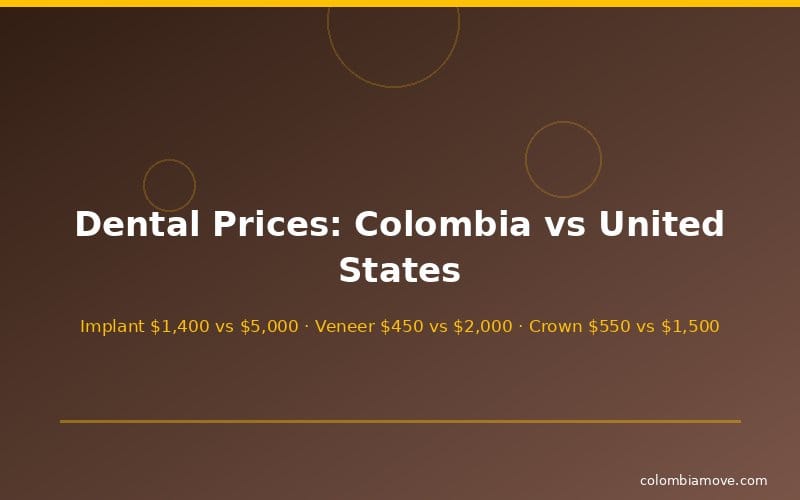
| Procedure | Colombia | United States | Savings |
|---|---|---|---|
| Dental implant + crown | $1,200–1,600 | $3,500–6,500 | 65–75% |
| All-on-4 (per arch) | $6,300–6,900 | $20,000–30,000 | 70–80% |
| Porcelain veneer (each) | $300–600 | $1,500–2,500 | 75–80% |
| Porcelain crown | $500–600 | $1,000–1,800 | 55–65% |
| Root canal | $150–200 | $700–1,200 | 75–80% |
| Cleaning + exam | $40–50 | $200–400 | 80–90% |
| Invisalign / clear aligners | $2,000–4,500 | $4,000–8,000 | 45–55% |
| Teeth whitening | $150–250 | $500–1,000 | 65–75% |
A few things to note: these are cash prices. Most clinics offer a small discount (5–10%) for paying in cash or by bank transfer. Credit cards are accepted at bigger clinics but sometimes carry a surcharge. And these prices are already low enough that insurance rarely enters the equation — more on that below.
My friend Sarah flew from Houston to Medellín for eight veneers. Total cost including flights, a nice Airbnb in Poblado for 10 days, and the dental work: about $6,500. She'd been quoted $18,000 back home. Even with travel expenses, she saved over $11,000.
Which City Should You Choose?
This matters more than most guides let on. There's a real price difference between cities, and the specialties vary too.
Medellín is the sweet spot for most dental tourists. Mid-range prices, tons of clinics used to working with foreigners, and the best selection of English-speaking dentists. The weather's perfect for recovery (not too hot, not too cold), and the city has great infrastructure for short stays. Most of the clinics I mention below are here.
Bogotá is where you go for complex surgical work. The city has Colombia's top maxillofacial surgeons and the most advanced hospital-based dental departments. Prices are slightly higher than Medellín but you get access to specialists that simply aren't available elsewhere. If you need full-mouth reconstruction, bone grafting, or anything involving surgery, Bogotá should be your first choice.
Cali is the cheapest option across the board — usually 15-20% less than Medellín. Fewer clinics market to foreigners, so you'll need decent Spanish or a translator. But the quality at top clinics is just as good. If you're budget-focused and comfortable navigating things in Spanish, Cali is underrated.
Cartagena — and I'll be blunt — is the worst value for dental tourism. It's a tourist city with tourist prices. Clinics there charge 20-30% more than Medellín for the same work, banking on the fact that cruise ship passengers and vacationers won't comparison-shop. Don't go to Cartagena just for dental work. If you're already there on vacation and need something done, fine, but don't plan a trip around it.
Clinics I'd Actually Recommend
I'm not going to give you a list of 30 clinics. Most of those lists are paid placements anyway. Here are the ones that I've personally used, that friends have used, or that consistently show up with verifiable reviews across Google Maps, Reddit, and the expat Facebook groups.
Medellín: Clínica Viena has been around for years and handles everything from cleanings to full implant cases. They have English-speaking staff and a solid reputation. Dental Specialists is another good option — more of a boutique feel, run by a husband-and-wife team who both trained in the US. International Smiles caters specifically to dental tourists with airport pickup and recovery coordination. Hollywood Smiles does a lot of veneer and cosmetic work.
Bogotá: Déntica is probably the most well-known premium clinic in the city — multiple specialists under one roof, very modern facility. Clínica Uribe has an excellent reputation for surgical cases and implants. Both are pricier than Medellín clinics but the complexity of cases they handle justifies it.
Cali: Dr. Juan Fernando Uribe (no relation to the Bogotá clinic) gets consistently great reviews for implant work. Finding English-speaking clinics in Cali is harder, so bring a Spanish-speaking friend or hire a medical translator for your first consultation.
Cartagena: If you must — Smile Makeover has decent reviews and works with international patients. But again, you're paying a premium for the location.
How to Vet a Clinic (and Red Flags to Watch For)
Don't just Google "best dentist in Medellín" and pick the first result. That's how you end up in a facilitator's office paying a 30% markup. Here's what actually matters:
First, check credentials. Every legitimate clinic should have ICONTEC or ISO 9001 certification. Look for the dentist's university — Colombia's top programs are Universidad de Antioquia, Universidad Javeriana, Universidad Nacional, and CES. If the dentist did a postgraduate specialization (especially in implantology, orthodontics, or endodontics), that's a strong signal. Ask to see their credentials — good clinics display them proudly.
Second, demand a written treatment plan before any work starts. This should include every procedure, every material being used (by brand name), a timeline, and a total price. If a clinic won't put it in writing, leave. Period.
Third, look at before-and-after photos. Not stock photos — real patient work. Most good clinics post these on Instagram. Check if the work looks natural. Overly white, perfectly uniform "chiclet" veneers are actually a bad sign — it means the dentist has one look they push on everyone.
Red flags that should make you walk out: No portfolio or only stock photos. A dentist who wants to grind down perfectly healthy teeth for veneers (this happens more than you'd think — it's destructive and unnecessary with modern bonding techniques). Prices that seem too good to be true — if someone quotes you $600 for an implant with crown, they're cutting corners somewhere. And the biggest one: commission-based facilitators who steer you to "their" clinic. These middlemen add 20-40% to your cost and their incentive is volume, not quality.
Planning Your Dental Trip
Timing depends entirely on what you're getting done. A cleaning, whitening, or simple filling? You can knock that out in a day or two. Crowns and veneers typically need 7-10 days — there's lab time involved while they fabricate your custom pieces, and you'll need a fitting appointment and possible adjustments.
Implants are the tricky one. The implant post gets placed first, then you wait 3-6 months for osseointegration (the bone fusing around the post). Then you come back for the crown. That's two separate trips. Some clinics offer "immediate load" implants where they place a temporary crown the same day, but this isn't suitable for every case. Be skeptical of any clinic that promises one-trip implants for complex cases.
My recommendation: fly in a day early to rest, have your consultation on day one, start work on day two. Build in at least two buffer days at the end for adjustments. Don't book your return flight for the day after your last appointment — things come up.
Insurance, Warranties, and What Happens If Something Goes Wrong
Let's be real: standard travel insurance does not cover elective dental procedures. Your World Nomads or Allianz policy will cover a dental emergency (cracked tooth from an accident), but not the veneers you planned in advance. This is a gap that catches people off guard.
What you should do: get a policy that covers complications from dental procedures — infection, allergic reaction, emergency revision. SafetyWing offers travel medical insurance that covers complications from medical procedures abroad, which is unusual. It won't cover the dental work itself, but if something goes sideways afterward, you're not stuck paying out of pocket for emergency care.
Most reputable clinics offer warranties on their work — typically 5-10 years on implants, 3-5 years on crowns and veneers. Get this in writing. Ask specifically what happens if something fails: will they cover the redo? Will they cover your flights? Some clinics will, some won't. Know before you commit.
Already Living in Colombia? Here's How Dental Care Works
If you're an expat already here, your dental situation is absurdly good compared to what you left behind. A cleaning and exam runs $40-50 at a private clinic, no insurance needed. I go every six months and it costs less than a single copay used to cost me in the US.
Your EPS (public health insurance) covers basic dental — cleanings, fillings, extractions. The catch: long wait times, limited clinic selection, and you don't get to choose your dentist. For routine stuff, it works. For anything cosmetic or complex, forget it.
Prepagada (private health insurance) plans give you faster access and better clinic options, but honestly? For dental, I just pay out of pocket. When a crown costs $550, the math rarely works out in favor of a monthly premium. The exception is orthodontics — if you or your kids need braces or Invisalign, a prepagada plan can save you a lot. Check out my guide to health insurance in Colombia for the full breakdown on EPS vs. prepagada.
Where to Find Honest Reviews
Skip the "dental tourism" websites — most of them are paid directories where clinics buy their placement. Here's where I actually look:
Google Maps is your best friend. Look for clinics with 100+ reviews and at least 4.5 stars. Read the negative reviews carefully — they tell you more than the positive ones. One bad review about wait times is fine. Multiple reviews about botched work or surprise charges is a deal-breaker.
Reddit (r/medellin, r/colombia, r/dentaltourism) has surprisingly detailed firsthand accounts. Search for specific clinic names. People are brutally honest on Reddit in a way they aren't on Google.
The Facebook expat groups (Expats in Medellín, Bogotá Expats, etc.) are hit-or-miss — lots of paid promoters in there — but if you search the group history you'll find legitimate recommendations. Dental Departures is one of the few review sites that actually verifies credentials, though they do take a referral fee. YouTube has a growing number of dental tourism vlogs with real before/after footage.
Frequently Asked Questions
❓ Is dental work in Colombia safe?
Yes — Colombia has 21 accredited dental schools and strict ICONTEC/ISO certification standards. The materials (Straumann, Nobel Biocare, E-max) are identical to what US clinics use. The key is choosing a certified clinic with verifiable credentials, just like you would anywhere else. Avoid unlicensed practitioners and too-good-to-be-true deals.
❓ How much can I save on dental implants in Colombia?
A single dental implant with a porcelain crown costs $1,200–1,600 in Colombia versus $3,500–6,500 in the United States — savings of 65-75%. Even after factoring in flights and accommodation, most people save $2,000-4,000 per implant. For full-mouth work like All-on-4, the savings can exceed $15,000 per arch.
❓ Do I need to speak Spanish to get dental work in Colombia?
Not necessarily. Many clinics in Medellín, Bogotá, and Cartagena have English-speaking staff specifically for international patients. In Cali, English is less common. Even at English-friendly clinics, having basic Spanish or a translator helps for discussions about pain management, aftercare instructions, and scheduling. Some clinics provide complimentary translation services.
❓ How long do I need to stay for dental work?
It depends on the procedure. Cleanings and fillings take 1-2 days. Crowns and veneers need 7-10 days for fabrication and fitting. Dental implants require two trips: 2-3 days for placement, then a return visit 3-6 months later for the crown. Plan buffer days for adjustments — don't book a flight the day after your last appointment.
❓ Does travel insurance cover dental tourism?
Standard travel insurance does not cover elective dental procedures. It will cover dental emergencies (like a broken tooth from an accident) but not planned work like veneers or implants. You should get a policy that covers complications from medical procedures — infection, revision surgery, emergency care. Some travel medical plans like SafetyWing cover post-procedure complications, which is critical to have as a safety net.
🦷 Planning Dental Work in Colombia?
Ask real expats about their experiences, get clinic recommendations, and share your results in the community.
Ask the Community →Have you gotten dental work done in Colombia? I'd love to hear about your experience — good or bad. Drop a comment below with the clinic name, city, what you had done, and what you paid. It helps other readers make better decisions, and honestly, the more data points we all share, the better.
🇨🇴
Get the next Colombia guide in your inbox
Join 10,000+ expats and future expats. No spam, just useful guides.


Comments
Loading comments...